Episodes · Episode 26
Can AI Learn Languages Humans Can't? Impossible Languages & Tokenization, with Julie Kallini
November 4, 2026 · 1 h 16 min · WiAIR Podcast • Season 2
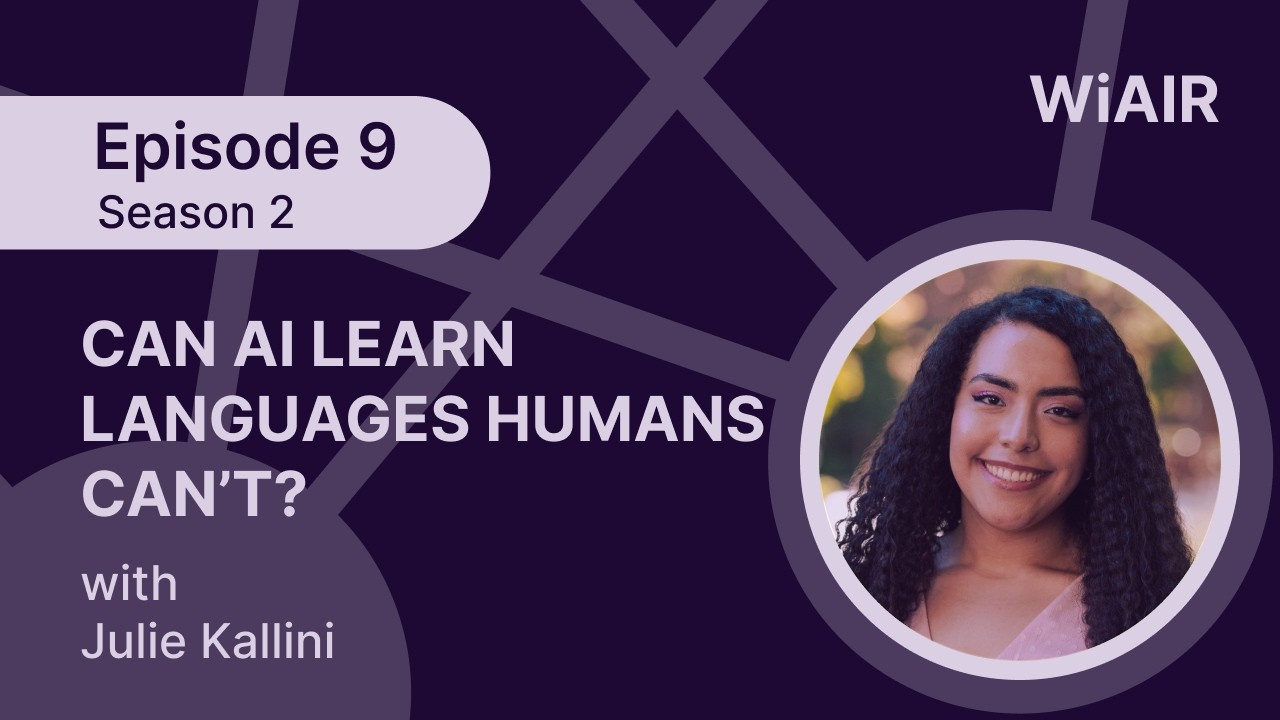
About this episode
Can a language model learn a language no human ever could? Stanford PhD researcher Julie Kallini put Noam Chomsky's claim to the test, and won the ACL 2024 Best Paper Award for it.
In this episode of Women in AI Research, Julie takes us from "impossible languages" to the hidden costs of tokenization, and shows how byte-level models could make LLMs faster, fairer across languages, and smarter about where they spend compute. We also talk about choosing a PhD advisor, leaving a software engineering job at Meta for a PhD, and what doing research at FAIR is really like.
Key points
- →Why it would be unethical to raise a child on an invented language, but not a language model
- →Why linguists still can't agree on what makes a language "impossible"
- →Why ChatGPT couldn't count the R's in "strawberry", and what tokenization has to do with it
- →How tokenization can make the same request cost more in some languages than others
- →MrT5: teaching a byte-level model to decide which bytes it can safely drop
- →Fast BLT: speeding up byte-level generation with diffusion and self-speculation
- →Diffusion vs. autoregressive generation: practical advice for practitioners
- →What's next: adaptive compression, or why spend dozens of tokens on the MIT license?
Chapters
- 00:00Finding the right PhD advisor
- 05:41Painting as a creative outlet
- 07:40From Meta software engineer to Stanford PhD
- 13:32Can language models teach us how humans learn language?
- 18:57Mission: Impossible Language Models (ACL 2024 Best Paper)
- 24:16What an "impossible language" looks like
- 27:44Why linguists can't define "impossible"
- 30:25Could you build impossible languages from scratch?
- 33:30From linguistics to tokenization
- 36:40The hidden costs of subword tokenization
- 41:29MrT5: dynamic token merging for byte-level models
- 46:26How MrT5 learns what to delete
- 50:10How close are byte-level models to everyday use?
- 52:37Fast Byte Latent Transformer: diffusion & self-speculation
- 58:41Research scientist at FAIR vs. academia
- 1:02:12Diffusion vs. autoregressive: advice for practitioners
- 1:05:13What people overlook about tokenization
- 1:08:48What's next: adaptive compression
Papers & links mentioned
- 📄 Mission: Impossible Language Models (ACL 2024, Best Paper)
- 📄 MrT5: Dynamic Token Merging for Efficient Byte-level Language Models (ICLR 2025)
- 📄 Fast Byte Latent Transformer
- 📄 Byte Latent Transformer: Patches Scale Better Than Tokens (Meta FAIR)
- 📄 Information Locality as an Inductive Bias for Neural Language Models (Someya et al., ACL 2025)
Full transcript
Read the conversation
00:00Finding the right PhD advisor
Julie Kallini
I think I did the classic machine learning thing, which is I said just try everything.
Jekaterina Novikova
Brute force.
Julie Kallini
Brute force. yes, but yeah, it's not a one size fits all thing. we waste a lot of computation. Models are wasting computation on parts of the input that are very predictable. why can't we just, let's say, compress something like the MIT license into one token and not spend a ton of tokens processing the MIT license when we're when we're processing a code base? the same English sentence translated into Thai will just take up like twice as many tokens or so, just by virtue of how Thai text is tokenized. So this can cause users of different languages to be charged for different amounts purely just because their language takes up more tokens.
We can't sit a baby down and teach it impossible languages. It wouldn't And it wouldn't be ethical to raise a child on some new synthetic language I made up. But we could totally do that with a language model, right?
Jekaterina Novikova
Welcome to the Women in AI Research podcast, And I'm really excited to have you here with us today. So first of all, I'd like to start our conversation with something that I think anyone who is doing a PhD right now deals with in one way or another. It's about finding the right mentorship. And you... are currently advised during your PhD by Chris Potts and Dan Jurafsky. My question would be, in your eyes, what makes an advisor a good one?
Julie Kallini
Yes, thank you so much for having me. it was a pleasure to meet you at COLM as well. And it's a pleasure to be at the yeah, to be on your podcast. and I've really enjoyed seeing your previous guests. So I just feel like I'm very happy to be joining such a wonderful lineup of women. Yes, so thank you so much. so a little bit about me. yes, I'm Julie Kallini and I'm a fourth-year computer science PhD student at Stanford. My advisors, as you mentioned, are Chris Potts and Dan Jurafsky. And I think I could spend the whole podcast singing both Chris and Dan's praises because they're really great. I'm so grateful to have them both as advisors.
And no doubt they're a huge reason why I've really enjoyed doing a PhD. But just so that, you know, we can wrap up the podcast on time, I'm going to only highlight a few things about what I love about both Dan and Chris. so I've actually worked with Chris Potts for longer than I've worked with Dan. at Stanford when you're admitted into the CS department, a faculty member indicates on your offer letter that they'd like to be your advisor. So for me that was Chris Potts. So I'm extremely grateful to him for changing my life because the PhD has been, you know it's really changed my life. and You know, Chris has this wonderful curiosity and ability to learn about almost any topic. if you go look at his list of students in his lab, he has students who work on a wide variety of topics.
But he still follows each project like very closely and very carefully. So I've just been amazed by his expertise on so many different research areas. And that's really encouraged me to kind of explore different research areas rather than being siloed to just one area. So in my PhD, I've been able to think about like computational linguistics questions, but also language model architectures, tokenization, efficient inference, and he's been really excited to advise all of those topics. My second advisor, Dan, he's also very he's wonderful and amazing. he also works on a wide range of range of topics. and I think he has this distinct ability to be able to frame research questions and think about the big picture.
So for me, sometimes I can get stuck in the weeds and details of individual experiments, but he really knows how to kind of make sure that the overall problem is impactful and yeah, really think about the big picture. He also knows the like perfect advice to write the perfect abstract and intro and all of the all of the things that are making sure your papers phrase frame the problem. Clearly and show why it matters. Both Chris and Dan are like these lifelong learners, which I think is part of what makes them great professors and great academics. And they're very kind people, so they admit kind students. So my lab mates are my colleagues, not only my colleagues, but they're also my friends. So to kind of go back to your question about what advice I'd give to someone who's picking an advisor.
05:41Painting as a creative outlet
Julie Kallini
I'd really say it's important to consider not only an advisor who's interested in the topics you work on, but can give you the feedback that's appropriate for you depending on your own needs and your own personality, and also who builds kind of a good community within their lab, which is what I've definitely found with both Dan and Chris.
Jekaterina Novikova
Yeah, that's interesting. It sounds from what you're saying that it's both the breadth of experience and the view, but it's also a structure at the same time is what is important. And you have both getting from those both people. And they also liked your advice that you should find that advisor who is giving the feedback that you need. The point is, when you're looking for the advisor, you only see the name, basically. It's a rare case when you could have interacted with the person previously, right?
Julie Kallini
Before you go into a PhD program, you kind of you don't know the faculty personally, which was true in my case. I actually hadn't met Chris or Dan before I applied to the PhD program and I met them for the first time after I was admitted. I'd say that usually the best way you can learn a bit about professors is through their students. So I did reach out to when I was making the decision process about which PhD program to join, I did talk to Chris's either former or current students to get a sense of like his advising style and his personality.
Jekaterina Novikova
People who know you from your papers might not know one interesting fact about you. The fact that at least I find interesting is that you also paint with the acrylics. Can you Mm.
07:40From Meta software engineer to Stanford PhD
Jekaterina Novikova
Share with me and all the listeners as well how painting became part of your life.
Julie Kallini
That's such a fun question. Yes, so I actually put I I have an acrylic painting hobby and I've put a few of my acrylic paintings on my website. The same academic website that hosts my research also hosts my paintings. so how did painting become a part of my life? Well, I really just enjoyed drawing when I was a kid. so I You know, maybe kids are outside running around. I used to just sit down and draw my favorite cartoon characters nonstop. So my mom still has several like three inch binders full of my drawings going back to when I was three or four years old. Thanks. I n I never took any drawing, painting, or art classes.
But it's just always been something that I've loved to do. Around the time I was a teenager is when I first started to take up acrylic painting. so my mom bought me some canvases and some paints and I just started to paint. I usually paint either like portraits actors or like a famous actors or people and also still life paintings. So yeah, it's just something that I've always used to kind of unwind. Maybe I listen to a podcast while I paint as well. So I can listen back to your podcast while I'm while I'm painting next time. and I think it's just generally sorry, I-I-I-I- good to have a creative outlet. I think the PhD is also a creative thing.
So yeah.
Jekaterina Novikova
Absolutely, So before your PhD, you spent nearly two years as a software engineer at Meta, right? Yes, that's right. How would you say this industry work compare with your experience of doing a PhD research?
Julie Kallini
Yeah, that's a great question. so I think it might be useful to get a little bit of context on, you know, why I was a software engineer and why I eventually went on to do a PhD. Mm-hmm. so for context, I actually didn't plan to do a PhD while I was an undergrad. I was an undergraduate at Princeton. And as a computer science major, I was a computer science major, and the thing that Computer science majors did after they graduate was go on to be software engineers. Usually that's just the path we take. So that's what I had planned to do. right before my senior year started, I had gotten a full-time offer from Meta, and that was out what I was going to do.
But at the same time, the interesting thing about Princeton is that it's a tradition to do a senior thesis. Or do some large research project during your senior year. So even though computer science majors are the only ones who are not required to do one, I still did one just to kind of keep with the Princeton tradition. And I worked with a wonderful computational linguist. Her name is Christiane Fellbaum. She's known for leading the WordNet project. And I really loved we worked on like something that was more of a kind of pure corpus linguistics research area. But I really enjoyed doing research with Christiana. And she was the one who kept telling me, like, Julie, you need to do a PhD.
And I really think she saw something in me, like that I had more of an academic inside me and kind of a potential to pursue like these bigger research questions. But I still went on to work at Meta. and When I was a software engineer, I really I did really value that experience. I was working more on like machine learning for the advertisements for Meta, which is, you know, one of the most impactful things in Meta in terms of driving the revenue for the company. it's just a very important part of how the company works. I do think that the difference between working as a there are differences between working as a software engineer at a company versus work working as a research scientist at a company.
So I can actually speak more to working as a research scientist at Meta maybe later during when we talk about one of one of the papers that came out of my recent internship. I was recently back at Meta as a research scientist intern. and that was a bit of a different experience from being a software engineer. Mm-hmm. but yeah, just to kind of speak on the general differences between industry and academia. I'd say like, especially now as people, you know, might be considering different career paths, the main variables in the research part. So to speak more about the research part, are how much like compute you have access to versus how much freedom you have to make your work open.
So these are going to be very individual factors and depend on an individual's specific goals. not only the individual person, but also what point you are in your career. There might be times where, you know, you you get to work on very exciting problems both in industry and academia. But do the problems you want to work on require tons of compute? that might be something to consider if you yeah, you might want to go to industry if you if you want to work on problems that can that need tons of compute. Or if your goal is more to create open research you might want to consider academia. but yeah.
13:32Can language models teach us how humans learn language?
Jekaterina Novikova
So what was your own motivation to go back to PhD after doing software engineering at Meta? Was it Yeah. the type of the problems or like the constraints or compute related questions, issues or Mm-hmm. anything else?
Julie Kallini
Yeah, so that's that's good. And that's why I should disentangle kind of working as a software engineer versus research at a company. I did feel like as a s as a software engineer, and I was working more on a product team, so like for the advertisements, you know, the the pace is very fast and it's very product facing. So you kind of have to deliver something. some new project every couple of months, right? And goals can change very quickly. I do feel like in a PhD or in a more of a research setting, you can have longer term goals and work on more open-ended and broader problems. And I think that those are the sorts of things that I really enjoyed while doing research.
At least the the research that I did with Christiana, it was like, yeah, yeah, very broad open problem. I can spend a lot of time on it. and that's those are that's also reflective of the types of problems I'm able to pursue during my PhD. so yeah, I'd say that if you like to work on something for a very long time and it might not have the clearest answer right in front of you, a PhD might be the thing for you if you enjoy that sort of that sort of thing.
Jekaterina Novikova
Amazing. And I think that's exactly the place where I would like to turn to your research and all the big questions behind it. Because what you're doing right now, you are working on those more ambiguous problems with no clear answer. And my I wonder, as an introduction to what you're doing, I wanted to say that there is that ongoing debate about whether language models can teach us anything about how we as humans learn language.
Where do you personally stand on that question?
Julie Kallini
Yeah, I think this is an excellent question. It's a it's a huge question for our field. it's not only something that concerns people who work on AI or machine learning, but also linguists and cognitive scientists. so yeah, this is something I've thought about a ton during my PhD. I'd first want to say I try not to or I think it's important not to overclaim what language models can tell us about human language learning. so I couldn't sit here and list all the ways that language models are not very much like humans at all. I think that sh that should be pretty clear. But it is remarkable that language models are like the only things other than humans that can learn and generate convincing human language.
And that's something that we've always taken to just be inherently unique to humans. There isn't any non-human animal that can use language or communicate in a similar way to us or quite like us. So in my view and the view of many other computational linguists, this is a real opportunity to be able to test claims about language acquisition and learning. This being the advent of language models and the success of language models at acquiring human language. So I think the yeah the most prominent question in linguistics that language models can come to bear on is something called the argument from the poverty of the stimulus.
So this is a question in linguistics. Mm-hmm. at a very high level, the argument is that knowledge of grammar or knowledge of language that children acquire is very limited. in the input, meaning children don't hear r that much language i in order to acquire in order to acquire language. So they've they have very limited language input. And because of that, because children are able to learn language very well and very quickly, that would require substantial innate structure and learning biases in their in their brains or in or cognitive, you know, cognitive biases for that.
Yet we have these language models that learn to generate fluent and convincing language without strong innate structures or learning biases. So they're they're very general learners. We don't hand engineer them, say, to follow the rules of English grammar, right?
18:57Mission: Impossible Language Models (ACL 2024 Best Paper)
Julie Kallini
The Transformer, which is like the building block inside of all of these language models, is very it's a very general learner and basically all it does is like create these vector representations of words using information from surrounding words and predict the next word given the previous words. And really just from this very general architecture and training objective, they can learn language very fluently. So I think that this has a lot to bear or this has huge like implications for the poverty of the stimulus argument and what parts of human language can be learned just from data alone without the innate structure. But of course there's like a lot of caveats. So language models consume way more data than any child.
So you know we really need to kind of you know make sure the claims are properly hedged, right? I think that there's Mm-hmm. a lot to be done on making smaller, more cog cognitively plausible models. So there's like work on this Or there's a data set called the BabyLM dataset, which is like a challenge in order to like design the best language model you can with like a small amount of data or data more that's more comparable to what a child would hear in the first like 10-ish years of their life. yeah, I think this is very cool. So I think just to summarize, language models ha can say a lot about questions of language acquisition. but we should just be careful to not say that they are acquiring language in exactly the same way as humans.
I think they c they can be good about kind of generating hypotheses or testing hypotheses. Yeah.
Jekaterina Novikova
And in terms of testing hypothesis, I think your paper, which is called the "Mission: Impossible Language Models", was one of such works that were testing one of those possible hypothesis about what kind of language can be learned by language model as a model of human language. And this paper, won the best paper award at ACL 2024, where it was published, and also got quite a lot of attention even after the conference. in this paper, you, with co-authors, created some synthetic languages that break the rules of natural human language.
And then train the language model, GPT-2 models on them. So could you walk us through what you were trying to find out in this work?
Julie Kallini
Yes, so I'm happy to talk more about the Mission Impossible Language Models paper. So yeah, this work was motivated in part by a New York Times article that Noam Chomsky published. At this point, it's been a couple of years. I think it was in 2023. so he and his co-authors argued that language models could learn possible and impossible human language equ languages equally well. so at a high level, what do we mean by ho possible versus impossible? according to where what we would take to be impossible would just be languages that have patterns that linguists hypothesize humans wouldn't be able to learn.
Like even if you gave a you sat a baby down and gave it tons the same amount of data, like expose it to the same language data in this impossible language. The baby wouldn't be able to acquire it, or would at least, you know, adapt or change that language in some way to make it resemble more of the patterns of possible human languages. And I'll talk a little bit more what about what those patterns are if we go into more experiment more details of the experiments a bit later. But at a high level, these are just languages that humans wouldn't be able to learn, no matter what you Mm-hmm. what you did. and Chomsky's argument wasn't that human language learning, or his argument was that human language learning is constrained in ways that language models aren't.
And therefore, you know, language basically he said that language models could learn almost any language. Therefore, they can't tell us anything about human language. I'm not so sure I agree even with that implication, but what we decided to test was the first part of the of that claim where language models aren't constrained in the ways that they learn. We wanted to test that claim. You so kind of yeah, drawing on the previous question, we can test that c claim with language models. you know, we can't sit a baby down and teach it impossible languages. people do artificial language experiments with children, but those are like extremely limited.
It wouldn't And it wouldn't be ethical to raise a child on some new synthetic language I made up. But we could totally do that with a language model, right?
24:16What an "impossible language" looks like
Julie Kallini
So in this paper, we took English text from that Baby LM dataset I mentioned. That's more it's a more cognitively plausible data set, so more along the lines of what a child might hear during their lifetime. And we just systematically kind of applied these Transformations to that data set to create these synthetic artificial languages with grammars that r resemble like impossible languages or languages that humans wouldn't be able to learn. And then we trained a bunch of small GPT-2 models from scratch on each version of this dataset in order to see whether the GPT-2 would learn the impossible language better than English as a control.
So so English is our control, train on the natural language. But not only how not only whether it learned the languages, but also how well it learned and how quickly it learned each language. And generally what we found was the models could learn natural language. For us that was just English, the unchanged BabyLM data set more easily. they could learn they can, you know, they can learn some of the unnatural languages too, but it wasn't learned as easily or as readily if we look at things like loss over training steps or perplexity over training steps. yeah, if you'd like I could talk more about the experiments or yeah.
Jekaterina Novikova
Yeah, let's talk a little bit more about that. for example, for those listeners who haven't read your paper yet, can you give an example of one of your impossible languages? for example, what would be a simple English sentence, how it would look like after you transform it into an impossible language.
Julie Kallini
Yeah, yeah, absolutely. so I think one of the weirder languages that we have, we call it like the Hop languages, but basically in English verbs have this marker for tense or agreement with the subject. So the example that I give in the paper is like he cleans his messy bookshelf or his very messy bookshelf. Like the S in cleans is kind of what marks that he is like a singular subject, and the verb has to agree with it. a very simple rule that you could a very simple way you could create a different rule that's you know equally expressive, meaning it expresses the same kind of subject-verb agreement, but in a way that a human wouldn't be able to acquire is if like this s that marks you know the agreement with the subject just appeared like four words later.
This is very simple. It's just you count four words later and you kind of deposit that's that suffix on whatever the fourth word later is.
27:44Why linguists can't define "impossible"
Julie Kallini
So this is actually like it actually there was a follow-up paper to our paper. I think it's Someya et al. I met him, but I didn't I'm hoping I pronounced his name correctly. who kind of like characterizes the entropy of all of our languages. So all of like we kind of state this in the paper implicitly, but didn't didn't do it outright. All of our languages actually preserve all of our languages barring one of them, which is the complete non-deterministic shuffling languages. All of them preserve the entropy, global entropy of the original English text. They also pr preserve like the next symbol entropy.
So this is basically just a measure of like how uncertain the model would be to predict the next symbol. So the text itself is inherently not more chaotic than Mm-hmm. the original English text, at least from information theory perspective. so t kind of to go back to the sentence that I stated, like the example I gave with marker for words later, this is like you know, completely preserves the same information of the original English text, but it's something that a human wouldn't be able to learn. we just don't kind of have rules that involve counting like that. and this is kind of r kind of robustly described in I guess theor theoretical linguistics literature.
Yeah.
Jekaterina Novikova
Right. given what you describe in your paper, you had multiple ways to create these different types of impossible languages. How did you decide where each language sits in that impossibility spectrum?
Julie Kallini
Yeah, that's a great question as well. so something I should be clear about that I think I didn't say explicitly previously is that linguists don't actually have an agreed upon definition of impossible versus possible. so that's why we present a continuum. I think if we had an answer Mm-hmm. to that question, we would have solved basically all of linguistics. you if you could be able to describe exactly what makes a language a human language or not.
30:25Could you build impossible languages from scratch?
Julie Kallini
And when we were c kind of putting this paper together, mainly that continuum was kind of a way to structure or categorize the different types of transformations we were trying to study, transformations on the English data, and you know, how much structure it preserves, whether it keeps information and the text close together, which is actually a very important property of natural language. It's that words that are predictive of each other tend to be close together in like the order in the sentence. This is called information locality. in general we like to keep the things that are very related to each other close together. So if you have a long something long that's going to come after take, you we tend to like to put out right after take.
So we'll say take out the trash that was very smelly and full of garbage, something like this, rather than Mm-hmm. say take the trash that was smelly and very full of garbage out, which is a little bit weirder. So this is information locality. The words that are predictive of each other like to be close together. Mm-hmm. also we just kind of especially with the example I gave previously about the verb conjugations, we also just kind of looked at linguistics literature and were inspired by, you know what sorts of things from theoretical linguistics have been said to be possible or impossible. So things like the counting pattern that I mentioned is something that kind of linguists I think It would be uncontroversial to say that's impossible.
Yeah.
Jekaterina Novikova
Yeah, what I'm also curious about is your impossible languages are transformations out of the normal possible English language, Have you maybe thought about creating impossible language from scratch rather than transforming natural language into impossible?
Julie Kallini
Yeah, that's a that's a great excellent that's an excellent question. so yeah, I think that w at the time we had considered like let's say designing something like context-free grammar. so maybe I I don't know if I should explain the details of context-free grammar, but this is basically like a generator, it can help you generate certain strings that follow a structure that I've kind of predefined. You know, you we could have designed synthetic languages from scratch. At the time, the reason why we went t we focused on transformations from English is number one, like we could do the sort of pre-training That could get you to train something like a GPT-2 and be able to generate fluent language, which you could you wouldn't
33:30From linguistics to tokenization
Julie Kallini
Necessarily be able to do with some very small set of like s if i let's say I tried to design like a small synthetic set of synthetic data of my impossible language. maybe you know p i it's something that lots of people research. It's like training very small models on kind of very synthetic or toy data. but we wanted to do something that's a little bit l larger scale. It's not super huge scale, but we could at least train s GPT-2 Small on that corpora. it also kind of allowed us to ch just tweak one thing about a about natural language and see what that effect would be.
It might be hard for us to design a synthetic language that is natural in every way, except for one thing that we want to change. whereas with this setup we were able to do that in a very controlled way. but there has been follow-up work that kind of does the same sorts of experiments that we've done, but trying to do yeah, more con more s like smaller, yeah, smaller synthetic languages. Like for instance the paper that I mentioned before, the Someya et al. paper, did use like probabilistic context-free grammars to generate languages with different structures, and I thought that was very cool. and I'm sure there's more there's more work that I don't have off the top of my head that does experiments of that sort.
I think there yeah. Yes.
Jekaterina Novikova
Right. that work on impossible language models that we have discussed so far, it was about which languages models can learn. But later, your research focus kind of moved a little bit away from that. towards the topic of tokenization or like how models read text. How did you get from one question to the other?
Julie Kallini
That's a that's a great question. so I was actually rotating during my first year, I was rotating with both Chris Potts and Dan Jurafsky, who, you know, would eventually be both of my advisors. and at the time I kind of was working on an interpretability project of character level models. So these are models that take in one character at a time or one byte at a time rather than entire words at a time. Most language models take in tokens which correspond to words or part of words. But these character models these character and byte level models will take in yeah, the individual letters at a time.
So each token is a letter. And I was doing some interpretability work on these models.
36:40The hidden costs of subword tokenization
Julie Kallini
But eventually I think it was maybe Chris Who suggested, why don't you actually, you know, there were so few models at the time working just at the character level. He's like, why don't you just work on making these better? Mm-hmm. so this is where I got into the space of working on what are called byte level or tokenizer-free models, and at the same time, just working on tokenization in general. And I think that also tokenization is one of those things that still has like a touch of linguistics in it, but still lots of engineering implications. I like to think about what's the best way to kind of split up text into words.
It's it feels like a almost a linguistics question. although I will completely admit that a lot of the methods don't involve linguistics anymore. Some of them do, but I just felt like it yeah, it felt close to home while still having large engineering implications and yeah, that's why I enjoyed it or I enjoy it to this day.
Jekaterina Novikova
I like that distinction between a linguistic approach and the engineering approach to tokenization. I personally always, like not always, but primarily look at that as an engineering decision because it's like tokenization is not only done with the language, it is done... with images and other types of data as well, Right. But yeah, it's interesting that you mentioned the linguistic view as well here. And also you have also mentioned that today almost every language model basically uses subword tokens, right?
Word or subword. tokens when it comes to preparing text for training. What is your take on the costs and benefits of this choice, the subword tokenization?
Julie Kallini
Yeah, absolutely. I do think that tokenization is an often overlooked part of a language model, but it's so fundamental to how the language model will learn and how it will process text. so first, you know, tokenizing text can be seen as a form of compression. We take a byte sequence or a text sequence, chunk it into subword tokens, and then those tokens are the Are what we pass into the language model. So having a more or less compressive tokenizer will then influence the model's compute. So a more compressive tokenizer means a model will spend more compute per string.
If you do more compression, that means you get, you know, each token packs in a lot more characters. So you get fewer overall tokens for a string. And that means less compute the model is spending per string. But for a less compressive tokenizer, let's say at the other extreme we do no compression, we just pass in individual characters, like I was mentioning before, that model will spend much more compute per string. So tokenization directly ties to the model's compute. It also ties to the model's vocabulary. A more compressive tokenizer will generally have a larger vocabulary. because it represents longer spans of text as a single token.
In turn, this will influence how big the model's embedding matrix is. So it will affect the model's overall parameter count. I think the crucial thing is to keep in mind is that all of these factors are decided before the language model is even trained. So the tokenizer is trained separately from the main language model. And you know, the so first you'll train your tokenizer and then you'll pre-train your language model once you've determined the tokenizer's vocabulary. And because the models are not trained to see They they don't have like direct access to the characters within the text, at least if it's using a subword tokenizer. this could create some like weird and undesirable model behaviors.
So the example I like to use a couple years back, you might remember, is like when ChatGPT didn't know how many R's are in Strawberry.
41:29MrT5: dynamic token merging for byte-level models
Julie Kallini
Mm-hmm. like there are a lot of factors that go into why, you know. of course there are a lot of factors that go into why ChatGPT would think that it only has two R's. but at the same time, like I think it's tokenization has like a strong effect there because you know ChatGPT will see strawberry as like token number, I don't know, five thousand, whatever, right? It's not gonna know that in d inside strawberry there are these three R's. It has to learn it implicitly. so that's one weird thing about tokenization. You don't have access to the characters that make up the units, make up the tokens. you know, changing one character could the if you insert a typo, you could just s make a word be tokenized into a completely different set of tokens, which will then, you know, influence compute and things that I mentioned before.
And then also like tokenization can just be bad for different languages. so I actually when I was teaching Stanford's natural language processing course, I I taught a lecture on tokenization and I gave this example of English and Thai text. Like you know, the same English sentence translated into Thai will just take up like twice as many tokens or so, just by virtue of how Thai text is tokenized. So this can cause users of different languages to be charged for different amounts purely just because their language takes up more tokens. Yeah.
Jekaterina Novikova
That's super interesting. Very nice example. So there are all those different problems that can and need to be solved when it comes to tokenization. Let's speak about your paper MrT5, Dynamic Token Merging for Efficient Byte Level Language Models. Can you walk us through what kind of model, what problem, sorry, not model, what problem you're trying to solve in this paper.
Julie Kallini
Yeah, absolutely. happy to. so yes, so this MrT5, we actually call it Mr. T5. Mr. T is like an American actor from the 80s. and I think both me and my advisor Chris were like very excited to have him kind of called out in the name of the this paper. but it's generally supposed to represent like merge T5 because we're kind of doing this merging of sequences with inside the model. I'll I'll I'll explain what I mean by this in a bit. But yeah, I was motivated to work on this project. I actually mentioned a bit of the origin a couple minutes ago when I was describing how like we had just decided to stop, you know, we're not going to do interpretability on the existing byte level models.
At the time there was really There were a few, but you know, the main ones were ByT5 and CANINE. CANINE was like Google's, both of them are Google's byte level models. and the main like ByT5 was very competitive with its T5 like the subword model that it's is like its corresponding subword model. very competitive in terms of performance, but the main issue is compute. because it's processing entire byte sequences on average. a subword token is four bytes. So if you're processing each byte as one token, you will have four times the sequence will be four times as long on average. so we kind of just said, why don't we make a better or more efficient byte level model?
And yeah, our motivation was, you know, could we take ByT5, which is already a very, you know. a competitive byte level encoder decoder model and see if we can make it more efficient. So it this was addressing mainly the compute the compute cost of operating ByT5. So the way MrT5 works is the MrT5 learns via a gate, like a how to like which bytes are relevant To be processed by the majority of transformer layers and which bytes can be kind of be pruned or deleted. And then it can kind of merge the bytes that are relevant into a shorter sequence.
So that's where the name comes from.
46:26How MrT5 learns what to delete
Julie Kallini
So yeah, ByT5 has this, you have your transformer encoder. after the few first few encoder layers, the bytes are contextualized, meaning they've kind of seen. they've gathered information from each other via the attention mechanism in the transformer, which kind of creates this mixing this mixing effect. at just a couple of layers, we put our MrT5 gate that learns what bytes can be dropped and what can be kept, making the sequence much shorter for the remaining process of the encoder. And that's that's the architecture at a high level.
And in our Main experiments we could like roughly half the sequence length just after a few layers, which could substantially in reduce the inference runtime. And it only has a relatively small increase in the loss compared to ByT5. And this is all done with minimal continued pre-training, meaning we took the pre-trained ByT5 and just kind of trained it to do this pruning. in a very few number of gradient steps of continued pre-training. So it's not like we pre-trained a whole model from scratch. I think that would be very interesting, but we at the time we didn't have the ability to kind of pre-train an entire MrT5 from scratch.
It might be completely matched performance with ByT5 if you could. yeah so that's the that's the gist of the that project.
Jekaterina Novikova
Right, and you have mentioned briefly already that the decision about which tokens to merge or delete comes from that gate that is learned, not a fixed rule, not some fixed rule. Can you speak a little bit more about what's the efficiency gain and how exactly the model decides what to keep and what can be removed safely.
Julie Kallini
Yeah, yeah, I'm happy to talk more about that. so how the model learns to remove tokens safely is all done via balancing the normal task objective. So for us most of the time that is like the language modeling loss versus a loss on the gate that puts some pressure on the gate to remove tokens. So it's a balance between these two losses. And the and really that's the only sort of influence we give to the model to delete tokens. We have no like sort of supervision on like these are the sorts of tok these are the sorts of bytes you should delete. Like n none of that.
The model learns it all implicitly all implicitly. And it's just using it's very similar to like a linear layer, so line Yeah, a linear layer on the hidden states of the model. So after each transformer layer, you output it outputs a vector that's a new hidden state, a new contextualized representation for that token. And it's like a very simple very simple gate on that representation. And we actually designed some synthetic tasks to kind of check what the gate was learning.
50:10How close are byte-level models to everyday use?
Julie Kallini
So these are very small synthetic tasks on small models to really kind of be able to see what the model would learn when we know what sort of merging or deletion rule is optimal. So, like for instance, we had these repeated patterns, like a translation task where there were repeated patterns, like every three consecutive characters, like A, B, C. always gets translated to the letter D, like something very simple, right? and the MrT model would learn that it could basically delete or remove positions B and C within the ABC sequence and still produce D with nearly with very high accuracy.
So it had learned that these three things, these three characters operate as a unit and this was an opportunity for compression. so those synthetic tasks were useful for kind of characterizing the model what the model can learn outside of like natural language data, which can be like more, you know, I guess more messy and less controlled. So yeah, we were able to kind of characterize that with synthetic tasks. and in terms of the efficiency gain, it's going to mainly come from putting you wanna put the gate as low as possible while still maintaining as much task performance as you can. So for us, that was like let's say I think it was a fourth of the way through the model's encoder. So the majority of the encoder is actually operating on a much shorter sequence.
So that's where the efficiency gain comes from. It's operating on a much shorter sequence for the majority of the transformer layers.
Jekaterina Novikova
Absolutely, and byte-level models became way more popular in the research community because they now can match token-based models on quality without needing all that subword vocabulary and all the associated issues solving. How close you think they are to everyday use right now in your view? Not in the research community, but in the AI.
Julie Kallini
Yeah, that's a great question.
52:37Fast Byte Latent Transformer: diffusion & self-speculation
Julie Kallini
One of the bigger issues that I actually worked on during my internship at Meta, so I joined the team behind the Byte Latent Transformer and worked on a follow-up to that is addressing the generation bottleneck. So let's say you have a model like MrT5 that does internal compression of the byte sequence. So it can you know, prune off bytes on the encoding side and process fewer bytes in the internal layers. at the decoder, w when it's still when it's generating, it still generates just one byte at a time. And this is this can be very slow for inference, even if you have a model that's doing the majority of the compute on shorter sequences.
Because actually when you're when you're doing auto regressive generation, so left to right generation, you this can create what's called like a memory bandwidth bottleneck because every time you generate a token you kind of have to load the model's parameters in memory. You have to load like the previous key value caches which are part of like a part of like the attention computation. You have to load those into memory. so yeah that could be a bottleneck. So I think a lot of it has to do I think a lot of the you know, what stands between byte level models and everyday use. It does have to do with efficiency and these engineering considerations.
And also the thing that I that I worked on at Meta was the generation bottleneck and memory bottleneck there.
Jekaterina Novikova
Right, and that's a great opportunity to speak a little bit about your paper, Fast Byte Latent Transformer that you already mentioned, where you just proposed several ways to speed up the BLT Byte Latent Transformer, the original version of that. Could you walk us through those three different methods that you have proposed?
Julie Kallini
Yeah, absolutely. I could talk a bit about where the also these ideas kind of came from. Or maybe first Mm-hmm. first I'll explain. Actually I'll first explain the different methods. So we I kind of tried a bunch of different things during my internship and put the things that worked well into one paper. so the main thing that I spent most of my internship working on was A new variant of the Byte Latent Transformer. Well, first I should give a an overview of the Byte Latent Transformer. It's another byte level model developed by Meta. It has like an encoder that processes byte sequences. It chunks them into these latent patches. So patch is the term that the BLT team uses for the kind of text segmentation that you that you get for BLT.
It's actually determined from like entropy spikes in the bytes. So it's still kind of it's not it's it's not determined by a tokenizer, but it's it's kind of dynamic determined by entropy spikes in the bytes. so after this encoder that processes bytes, it processes it kind of pools them into these latent tokens that are then processed by them in like by a big transformer. yeah, so these patches are pooled into latent tokens into this big transformer and then a decoder at the top decodes from those patches back into bytes. and that's all of this is auto all of this model is auto-regressive. And what I did was I created a new version of BLT, a new model.
It was BLT Diffusion. So this was a brand new model. It's trained on both next byte prediction and And a masked recon kind of reconstruction of these masked blocks. That's the text diffusion part. So I should also explain text diffusion. It's very similar to BERT. If you remember BERT, BERT has these masked tokens and BERT learns how to kind of fill in the mask tokens. diffusion is very similar. You can imagine gener generating from a BERT model by let's say feeding in A sequence of all masks, like all mask tokens to the BERT model. You pass it through BERT and it let's say it unmasks a couple of tokens, like whatever it was most confident about.
You could then feed that sequence back into BERT with the few couple of tokens revealed, but still mostly mask tokens. You do another iteration. you clean or clean up or unmask a few more tokens. You do this repeatedly until you've generated a sentence. That's basically what you can think of text diffusion. You can think of text diffusion as this way. And yes, the main the main thing here is that because you can unmask many tokens at a time, you can actually generate faster rather than just generating one token at a time. So I basically took this masked diffusion idea and put it on top of BLT to make to unmask multiple bytes at a time.
And this is what makes the model faster. the other the other variations are both inspired, or the other variations of things that I tried. There's a BLT Self-speculation and a BLT Diffusion + Verification. I know there's many variants in this paper, but both are more inspired by speculative decoding.
58:41Research scientist at FAIR vs. academia
Julie Kallini
Which is this idea that you can use a small model to kind of draft sequences for a larger model. And the smaller model can run fast. The bigger model can verify the models, the small model's generations very quickly. So we applied this into the BLT setting. We actually found that BLT's decoder, if you let's say just allowed the decoder to generate long sequences, it serves as a very good draft model for the entire BLT model, which is something cool that I don't think anyone has really looked at for architectures of this type that have modular components. Like just take the decoder and use it as a draft model for the entire model. And it's since it's trained with the model, it's actually very aligned with it.
Because you need a draft model that's well aligned with your target larger model in order for speculative decoding to work well. So yeah, this is I think so the the s BLT self-speculation, it was also in the fast BLT paper. We just kind of packaged everything together. Mm-hmm. I think there were a lot of yeah, a lot of findings in that paper. the diffusion was a brand new model, which is kind of why we put it at the forefront. But speculative decoding in the same way that diffusion is kind of viewed as like a parallel generation method, meaning you can generate more tokens at a time. So so is speculative decoding.
So we were exploring all of these kind of topics in order to address BLT's generation inefficiencies. so all of these things are in the fast BLT paper.
Jekaterina Novikova
And also, like, you now have that experience of working at Meta as software engineer before doing your PhD and now as a research scientist and you promised us in the beginning of the Right. episode to speak a little bit about that difference.
Julie Kallini
Yeah, so at the beginning of the episode I talked a bit about being a software engineer at Meta. During my research scientist internship, I was a part of FAIR, so that's Facebook AI Research, or after it's been re renamed to Meta, it's now called Fundamental AI Research. and I was in Seattle. So the team there is wonderful actually. So th there's a lot of kind of connections to University of Washington. So a lot of people in the office were like other PhD students from UW or also professors who work part-time at Meta. so really working in FAIR felt like working in an academic lab, but just with more resources.
So everyone there is really everyone there was really excited about you know the same sorts of topics as me. Everyone was also very into the byte level models and token tokenizer research and they're academics too. So you know, we read papers together. a lot of them go to conferences. So I was at we were both at COLM last week, the conference on language modeling. a lot of my former co-workers from FAIR were also at that conference. so really working in FAIR was like working at a academic lab. That's at least that's how it felt to me at the time of my internship.
1:02:12Diffusion vs. autoregressive: advice for practitioners
Julie Kallini
Whereas I think during my software and time as a software engineer it was very, very product focused and a different environment altogether.
Jekaterina Novikova
Right, so it sounds like it's maybe a more straightforward decision in choosing between software engineering job versus PhD research job, while the choice between a research scientist in the industry versus research in academia is the difference between them. it's way more blurry.
Julie Kallini
Yeah, I would say so because I felt like I was doing very cool research at Meta. at the same time I have more compute resources, especially because a lot of my research involves language model pre training, which requires tons of resources. And if you want to train at the sort of scale where you can get very impressive capabilities, it's just usually not something you can get in like just from a university budget, but the companies can really help with that. so if your research direction is very compute intensive, a nice research lab at a company could be a great option. At the same time, you know, still when you work at a company, there are some considerations about what you can work on, what you can publish.
So yeah, they're all sorts of considerations. To keep in mind.
Jekaterina Novikova
I see. Yeah, that's interesting to hear. Let's slowly move towards wrapping up our conversation. When you presented this last... work of yours on the Fast Byte Latent Transformer, you spoke a bit about diffusion versus autoregressive generation. And these two approaches, they are often seen as competing approaches when it comes to language. Do you have any advices for practitioners that would love to choose one method versus another for some of their own use cases?
Julie Kallini
Yes, that's a great question. so kind of going from or kind of drawing from the way I operated during my internship and trying a bunch of different things, I think that if you need to guarantee you need to guarantee a certain performance.
1:05:13What people overlook about tokenization
Julie Kallini
Auto-regressive models are right now are tend to outperform diffusion models. and if you want some speed ups, speculative decoding is a very promising way. It's it's a completely lossless way to speed up your model. but if you need very fast generation, I think diffusion at some cost in performance, text diffusion seems promising to me. Although, yes, it is true that diffusion is, I guess, at this moment in time more experimental. who knows like what the next couple years will bring. They might they might completely take off. especially with the methods of kind of drawing from some of the benefits of auto-regressive modeling, like KV caching, as I mentioned before.
But in general, the yeah, the major trade-off with diffusion is the performance. But if you need a if you need a very large speed up, which is what we saw also saw in the paper, the diffusion model was able to be very fast. at the same time, it's worth also comparing to just having a smaller autoregressive model and seeing if you can just, you know, take a performance hit by having a smaller autoregressive model. but hopefully or you know it would be kind of faster to run than a larger autoregressive model. So having all of these comparisons in place is important. I think I did the classic machine learning thing, which is I said just try everything.
Jekaterina Novikova
Brute force.
Julie Kallini
Brute force. yes, but yeah, it's not a one size fits all thing.
Jekaterina Novikova
I see. You have done a lot of work in the area of tokenization. Based on your experience, what are the things that are very easy to overlook when we think about tokenization?
Julie Kallini
Yeah, that's a great question. I would say the probab maybe the biggest thing that people overlook in general is just how well their tokenizer tokenizes their specific domain. We talked a lot about, you know, applying tokenizers to other languages, but we haven't, you know, talked about How tokenizers work on different domains. Like let's say a tokenizer trained on English wouldn't necessarily be the best tokenizer for code or the best tokenizer for HTML. there are plenty of other domains. Like we can even think about starting to go when thinking about like multimodal things.
The tok that's beyond my expertise, but Tokenizers for different modalities, or when you want to, let's say, model both text and images together or something like that, you know, the way you encode that data is very important. Ki I kind of talked about how the tokenizer defines the compute cost when modeling text. But the tokenizer could also, you know, in a multimodal setting, let's say determine how much bias the text has versus the image. If you encode the text into a lot of tokens and but encode the image into like let's say some fixed 256, like people usually split up an image into like a 256 set of patches, like a grid.
1:08:48What's next: adaptive compression
Julie Kallini
If your text that's actually like relatively short and less information has less information than the image, is tokenized into the like also like hundreds of tokens, but your image is only 256 tokens. You're biasing how much the model is going to get learning signal from the text versus the image. Yeah, there so I I guess to summarize what I've just said is yeah, really think about how your tok tokenizer works in different domains. If you're going to be applying an off-the-shelf tokenizer from some, like let's say from Hugging Face, you just download some off-the-shelf tokenizer. how well does it actually work for your domain?
Is is it what is your domain? Is it language? Is it code? what are you doing with that tokenizer? Yeah.
Jekaterina Novikova
That's a very interesting open question that I think it's worth keeping in mind.
Julie Kallini
Yeah. I should also add to add to that question, I just remembered, yeah, tokenization can really affect how models do arithmetic. So having access to individual digits actually makes the model better at math and generalizing on math. whereas, you know, I think many for a long time many tokenizers will just kind of chunk a number into three digit chunks. which is bet that's that's fine, but you can actually get better performance on math by considering tokenizing digits individually. Yeah. So this is just another example of thinking about the domain.
Jekaterina Novikova
Mm-hmm. Yeah, it definitely makes more sense. Yeah. Absolutely. Yeah. So if to summarize all the work that we have discussed today during the episode, like the work on the impossible language models, the tokenization, multilinguality, What are some open questions that you're most excited about and would love to work on next?
Julie Kallini
Yeah, I'd be happy to tack talk more about what I'm thinking about next. but yeah, I think the through line through all of my research has been thinking about how models represent data and how well they learn from that data. And I've actually been thinking a lot more about kind of my architecture work. That has been mainly on byte-level models and how to best compress byte sequences into these useful internal representations for language modeling. But in reality, these architectures could be applied over subword tokens as well. Like let's say you love your subword tokenizer. These architectures could make any model more efficient.
And what I've been thinking about is like, How can we, what is the best way to represent, or how can models learn on their own what to represent in detail and then what they can compress? So I've kind I'm kind of calling this adaptive compression. Because in general, whether you're talking about bytes or you're talking about subword tokens, an input's length doesn't necessarily tell you how much information that text contains. So if we go to like a coding example, a short function inside of a big code base could be more information dense than let's say a long block of boilerplate code. why can't we just, let's say, compress something like the MIT license into one token and not spend a ton of tokens processing the MIT license when we're when we're processing a code base?
When we could be spending that compute on shorter functions that actually matter. But since we def decide these tokens on it in advance, we waste a lot of computation. Models are wasting computation on parts of the input that are very predictable. And I'm basically thinking about how we can kind of think about the sort the same sorts of compression problems that we think about for byte-level models, but just for broader questions like related to long context modeling. For instance, like that, you know, getting in general models to be able to fit longer context windows in order to process something like a large code base more efficiently.
Also things like test-time scaling. So when yeah test-time scaling is basically this idea that if you use more compute at test time you can get better capabilities out of your model. And compression could be another factor there. how much you compress an input versus how much you keep it like kind of fine-grained and finely represented that allows you to spend more compute at test time to get more performance on the parts of the input that matter. So these are very high-level ideas, but basically taking the kind of learnings that we've had from trying to model bytes and just applying it to broader domains to make models more efficient and more flexible. and be able to process data in the you know, learn how to process their data end to end.
Yeah.
Jekaterina Novikova
Yeah, that's awesome. I look forward to seeing your new papers in the next conferences that are discussing some of those questions. looks like you are turning towards code as data, other than language, but I would love to see anything that you are going to come up with.
Julie Kallini
Yes, so I'm very excited about yeah, continuing topics on tokenization, continuing topics on architectures. I still love linguistics and I have a lot of like computational linguistics thoughts in my head all the time. but also applying these architectures to different modalities I think is very promising as well.
Jekaterina Novikova
I agree. Thank you very much for your time today.
Julie Kallini
Yes, thank you so much. It was such a pleasure to come onto your podcast.
Jekaterina Novikova
Thanks for watching this far. If you know a researcher who would get something out of this episode, please share it with them. Here is one more thing. I'd love for 50 % of you watching to be subscribers. If you enjoy these conversations with the brilliant women in AI research, just hit subscribe and it's the easiest way to support the show. It will help me to keep bringing you new guests
Julie Kallini
And new episodes.
Jekaterina Novikova
Now what should you watch next? I think you would love this one and this one. Check it out and I will see you in the next episode.
Click a timestamp to play the episode from that moment on YouTube.